Blog
Darbandikhan Tunnel Reconstruction by Sahi Rasa Technical Consulting Service

In September 2022 the technical engineering team of Sahi Rasa was engaged by a private Iraqi company as industrial consultant for the reconstruction of the Darbandikhan Tunnel in Sulaymaniyah Governorate, Kurdistan Region of Iraq. Sahi Rasa’s core responsibility consisted of preliminary studies, field survey and mapping, detailed technical condition assessment, preparation of the bill of quantities and bill of materials, definition of execution methods, estimation of project duration, calculation of budget and full identification of technical and logistical requirements. Once this complete engineering package was finalised, all documentation was handed over to the executing contractor so that physical works could proceed on a clear, pre-defined basis.
The Darbandikhan Tunnel, constructed in 1959, remains the primary road link between Sulaymaniyah city and the Garmian administrative areas. Decades of heavy traffic, limited maintenance, water ingress, the effects of the 2017 earthquake and repeated rockfalls near the portals had left the concrete lining, lighting, ventilation and road markings in a degraded state. A systematic engineering intervention was therefore required.
Sahi Rasa approached the assignment with the same industrial-engineering discipline applied to manufacturing plants: first diagnose the existing asset, then define the required performance standard, quantify every intervention and deliver a transparent, executable package ready for handover to the contractor.
Preliminary Studies and Field Survey
The Sahi Rasa team inspected the full length of the tunnel and both portals. Key observations included surface irregularities, cement laitance, bitumen stains, protruding reinforcement, differential settlement at formwork joints, accumulation of dust, soot and chemical residues, incomplete or faded centre and edge lines, missing or damaged reflective cat-eyes, non-standard lighting density, inadequate mechanical ventilation capacity, low-mounted cable trays in places, and portal architecture lacking modern reflective or symbolic safety elements. These findings formed the baseline for every subsequent calculation.
The Sahi Rasa team conducted an on-site inspection of the full tunnel length and both portals. Key observations recorded during the survey included:
- Surface irregularities, cement laitance, bitumen stains and protruding reinforcement on the concrete lining
- Differential settlement between formwork joints
- Accumulation of dust, soot and chemical residues on walls and ceiling
- Incomplete or faded centre-line and edge-line markings
- Absence or deterioration of reflective cat-eyes
- Inadequate permanent lighting arrangement relative to current traffic volumes
- Limited mechanical ventilation capacity for peak traffic conditions
- Cable trays installed at non-standard low height in places
- Portal architecture lacking modern reflective or symbolic safety elements
These findings formed the baseline for the subsequent engineering package.
Sahi Rasa organised all required operations into clearly defined work packages with methods, material specifications, consumption rates and unit costs so that the executing contractor could proceed without ambiguity.
Scope of Reconstruction Works Defined by Sahi Rasa
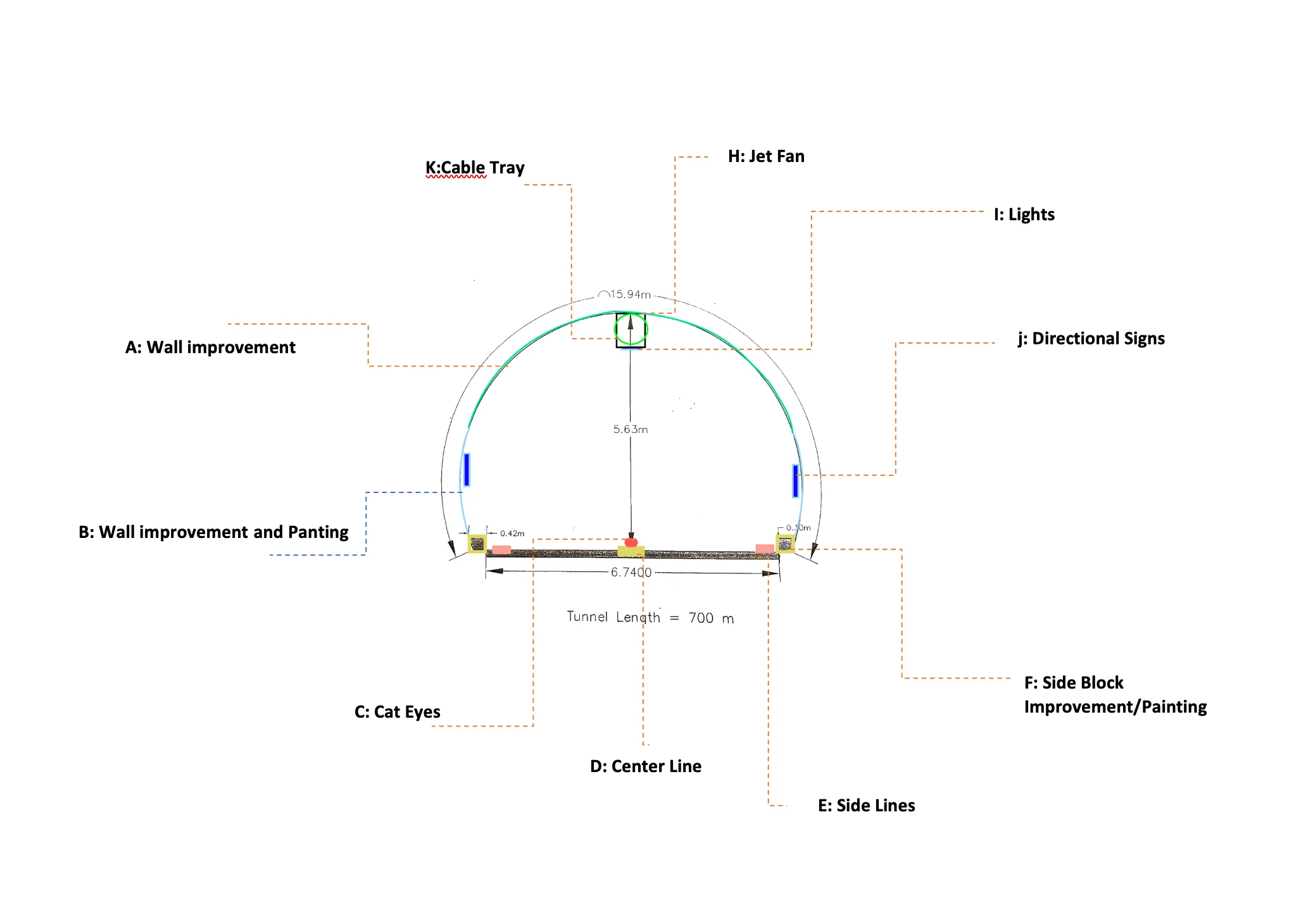
The consulting package organised all required operations into clear work packages with methods, material specifications and unit costs. The principal packages are summarised below.
A & B – Wall Improvement and Painting
Seven sequential operations were defined:
- Mechanical removal of surface protrusions, cement secretions, bitumen residues and reinforcement wires (cutting, brushing, milling).
- High-pressure water-and-sand cleaning (200–500 bar) to remove dust, grease and chemical contamination.
- Two-stage caulking with specialised putty to fill grooves and level the concrete surface.
- Application of acrylic-based primer (minimum 15 microns, pull-off strength ≥ 2 MPa) to ensure adhesion.
- First coat of odourless water-based acrylic paint with modified resin (minimum 50 microns).
- Second coat of the same system for full coverage and uniformity.
- Final nano-material top-coat for dust resistance, washability and long-term protection.
C – Cat-Eyes
Installation of 1 400 reflective road studs along the centre line, fixed by nails or specialised adhesive, to improve night-time guidance and reduce lane-deviation risk.
D & E – Centre and Side Lines
- Centre line: continuous yellow, 15 cm wide, total area 105 m², two-component road-marking paint applied by mobile spray equipment at minimum 2 000 microns thickness.
- Side lines: continuous white, 10 cm wide, total area 140 m², same high-build system.
F – Side-Block Improvement and Painting
Repair of damaged concrete kerbs, angular reconstruction, surface concreting and application of black-and-yellow (or red-and-yellow) safety paint on approximately 210 m² of kerb faces.
J – Directional and Informational Signs
Supply and installation of a complete set of regulatory and guidance signs (triangular, circular and rectangular formats) with short and long posts, covering speed limits, height restrictions, direction and emergency information.
H – Mechanical Ventilation
Installation of ten axial jet fans (Siemens-type aluminium propeller, ST37 steel housing, 3 hp, 1 400 rpm, 30 000 m³/h each). The total ventilation capacity was calculated to achieve full air exchange under peak traffic conditions (approximately 300 000 CFM requirement reduced for the observed 25 % traffic load). Cable-tray height was specified to remain below one metre for aerodynamic efficiency.
I – Lighting
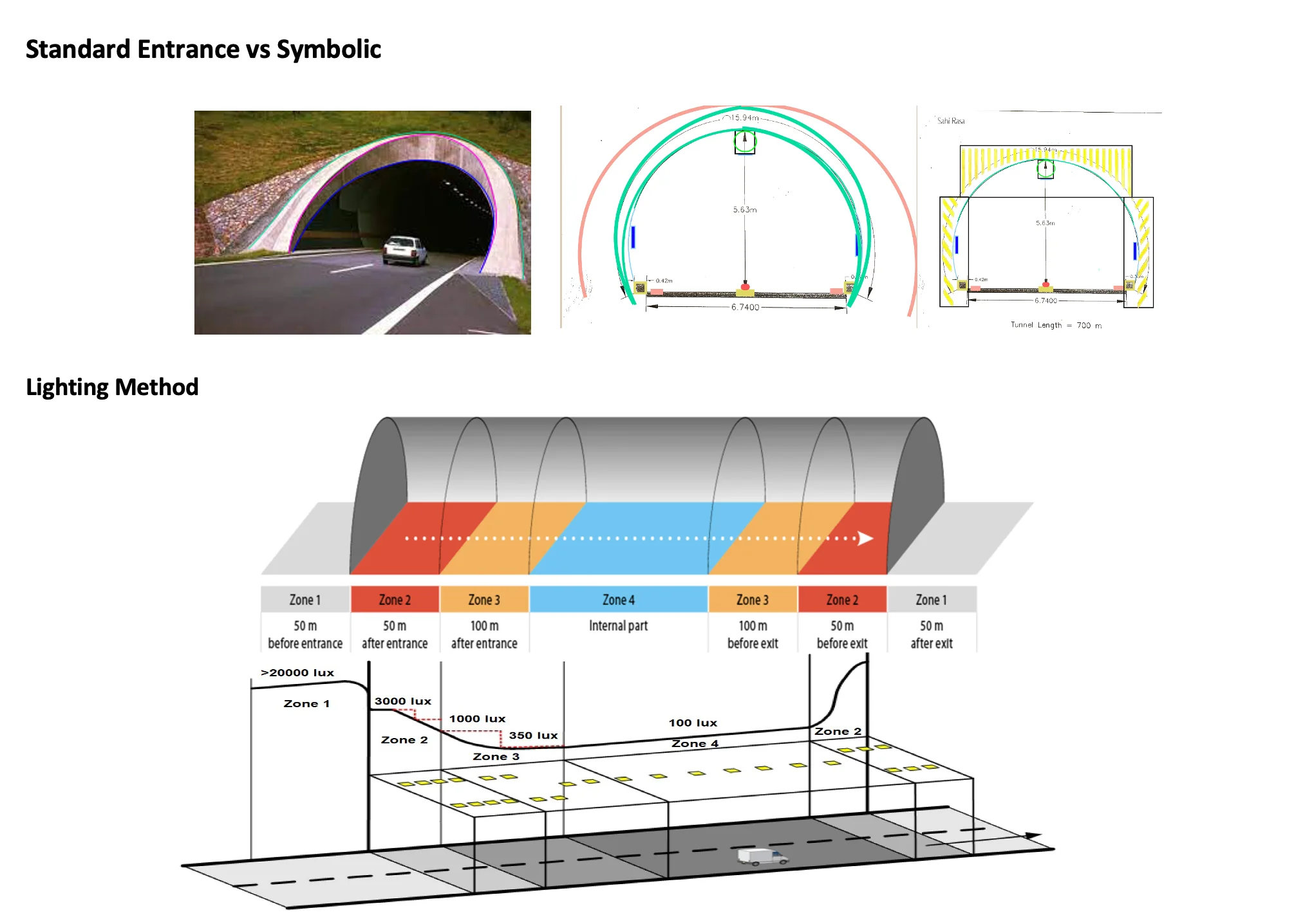
A complete LED lighting system designed according to the four-zone tunnel lighting standard. Approximately 1 400 luminaires of 150 W each are arranged perpendicular to the roadway beneath the cable tray. Entrance and exit zones receive double density during daytime. Cable tray (1.25 mm thickness, 30 cm width, 750 m length) carries both power and control wiring.
Entrance / Exit Architecture
Standardised portal treatment using reflective safety boards or symbolic architectural elements on both sides, providing clear visual transition and improved driver orientation.
Additional packages covered temporary traffic management (cones, New Jersey barriers, scaffolding), on-site temporary utilities, worker accommodation for a 90-day programme under cold-weather conditions, and logistics for materials and equipment.
Engineering Principles Applied
Sahi Rasa treated the tunnel as a linear industrial facility requiring the same level of process control and quality assurance used in factory projects:
- Surface preparation quality directly determines coating durability; therefore multi-stage mechanical and chemical cleaning was mandated before any paint application.
- Lighting and ventilation were sized from first principles (traffic volume, tunnel cross-section, smoke-extraction requirements) rather than simple replacement of existing fixtures.
- Road-marking systems were specified with high-build two-component materials to withstand heavy truck traffic and frequent wet-cleaning cycles.
- All permanent installations (fans, luminaires, cable trays) were coordinated to avoid aerodynamic interference and to maintain the required free cross-section.
Project engineering costs were carried by Sahi Rasa; supervisory fees, customs duties, asphalt resurfacing and local residence permits were excluded from the base estimate and flagged for separate client decision.
Role of Sahi Rasa as Industrial Consultant
The company’s contribution went beyond simple quantity surveying. The team:
- Performed independent field verification rather than relying solely on client data
- Produced a fully itemised method statement for every operation
- Linked each cost item to a clear technical specification and acceptance criterion
- Provided a realistic programme (approximately 90 working days under the stated weather constraints)
- Identified interfaces with traffic management and temporary works that are often overlooked in pure construction tenders
This approach mirrors the industrial-consulting methodology Sahi Rasa applies to manufacturing plants: diagnose the existing asset, define the required performance standard, quantify the interventions, and present a transparent, executable plan.
Contextual Importance of the Tunnel
The Darbandikhan Tunnel remains a critical artery for commercial traffic, including heavy fuel tankers, between Sulaymaniyah and the southern districts. Aging infrastructure, earthquake-induced cracking and repeated rockfall events near the portals have repeatedly disrupted this corridor. Systematic rehabilitation of lining, lighting, ventilation and road markings is therefore not merely cosmetic; it is a safety and reliability intervention for a high-volume transport link serving the Kurdistan Region and connections toward Iraq proper and neighbouring markets.
Handover to the Executing Contractor
After completion of the preliminary studies, technical engineering review, definition of execution methods, quantity take-off, duration and budget estimates, the full documentation package was formally handed over to the executing contractor. Sahi Rasa’s role as consultant concluded at the point of precise definition of all requirements; responsibility for physical execution, final material procurement and on-site implementation rested with the contractor.
Project Significance and Sahi Rasa’s Consulting Role
The Darbandikhan Tunnel continues to serve as a critical artery for commercial and fuel-tanker traffic between Sulaymaniyah and the southern districts. Systematic rehabilitation of the concrete lining, standards-compliant lighting, adequate ventilation and durable high-visibility road markings constitutes an essential safety and reliability intervention for this high-volume corridor serving the Kurdistan Region and regional connections.
By combining independent field verification, rigorous technical analysis and a fully transparent, itemised engineering package, Sahi Rasa demonstrated how disciplined industrial consulting reduces project risk and enables a clean handover to the executing party. This assignment reinforces the company’s position as a reliable technical consultant for both industrial plants and linear infrastructure assets across the region.
For further information on industrial and infrastructure consulting services, readers may consult the Sahi Rasa portfolio, the turn-key services page, the main company website and the order and supply-chain section.